Candlemas / Purification /Presentation / Our Lady of Candelaria

Candlemas / Purification /Presentation / Our Lady of Candelaria

Jewish women went through a purification ceremony 40 days after the birth of a male child (80 days after the birth of a female child) and brought a lamb to the temple to be sacrificed. According to Mosaic law, Mary and Joseph would also have brought their first-born son to the temple forty days after his birth to offer him to God, like all first-born sons, along with a pair of turtledoves.

The Presentation was originally celebrated in Jerusalem on November 21st but once Christ’s birth was fixed on December 25th (near the winter solstice), the Presentation and Purification rituals would fall forty days later, in early February when torches were carried around the fields.

First celebrated on February 14th, in 350 at Jerusalem, when it would have coincided with the Roman festival of Lupercalia, it was later moved up to February 2nd. Pope Sergius declared it should be celebrated with processions and candles, to commemorate Simeon’s description of the child Jesus as a light to lighten the Gentiles. Candles blessed on this day were used as a protection from evil.

This is the ostensible reason given for the Catholic custom of bringing candles to church to be blessed by the priest on February 2nd, thus the name Candle-Mass. The candles are then taken home where they serve as talismans and protections from all sorts of disasters, much like Brigid’s crosses. In Hungary, according to Dorothy Spicer, February 2nd is called Blessing of the Candle of the Happy Woman. In Poland, it is called Mother of God who Saves Us From Thunder.

Actually this festival has long been associated with fire. Spicer writes that in ancient Armenia, this was the date of Cvarntarach, a pagan spring festival in honor of Mihr, the God of fire. Originally, fires were built in his honor in open places and a lantern was lit which burned in the temple throughout the year. When Armenia became Christian, the fires were built in church courtyards instead. People danced about the flames, jumped over them and carried home embers to kindle their own fires from the sacred flames.

The motif of fire also shows up in candle processions honoring St Agatha (Feb 5) and the legends of St Brigid (Feb 1). The fire represents the spark of new life, like the seeds blessed in northern Europe on St Blaise’s Day (Feb 3) and carried home to “kindle” the existing seed.

The English have many rhymes which prognosticate about future weather based on the weather on Candlemas Day:

If Candlemas Day bring snow and rain
Winter is gone and won’t come again
If Candlemas Day be clear and bright
Winter will have another flight.

These are all similar to the American custom of predicting the weather on Groundhog’s Day, in that you don’t want the groundhog to see his shadow. In Germany, they say that the shepherd would rather see the wolf enter his stable than the sun on Candlemas Day.

The ancient Armenians used the wind to predict the weather for the coming year by watching the smoke drifting up from the bonfires lit in honor of Mihr. The Scots also observed the wind on Candlemas as recorded in this rhyme:

If this night’s wind blow south
It betokeneth warmth and growth;
If west, much milk and fish in the sea;
If north, much cold and snow there will be;
If east, the trees will bear much fruit;
If north-east, flee it, man, woman and brute.

This was also a holiday for Millers when windmills stand idle. In Crete it is said that they won’t turn even if the miller tries to start them.
Blackburn, Bonnie and Leofranc Holford-Strevens, Oxford Companion to the Year, Oxford University Press 1999 Kightly, Charles, The Perpetual Almanack of Folklore, Thames and Hudson 1987
Spicer, Dorothy Gladys, The Book of Festivals, The Woman’s Press 1937, GrannyMoon’s Morning Feast

Today We Honor The Goddess Athena

In Greek religion and mythology, Athena or Athene (play /əˈθnə/ or /əˈθn/; Attic: Ἀθηνᾶ, Athēnā or Ἀθηναία, Athēnaia; Epic: Ἀθηναίη, Athēnaiē; Ionic: Ἀθήνη, Athēnē; Doric: Ἀθάνα, Athana), also referred to as Pallas Athena/Athene (play /ˈpæləs/; Παλλὰς Ἀθηνᾶ; Παλλὰς Ἀθήνη), is the goddess of wisdom, courage, inspiration, civilization, law and justice, just warfare, mathematics, strength, strategy, the arts, crafts, and skill. Minerva, Athena’s Roman incarnation, embodies similar attributes.[4] Athena is also a shrewd companion of heroes and is the goddess of heroic endeavour. She is the virgin patron of Athens. The Athenians founded the Parthenon on the Acropolis of her namesake city, Athens (Athena Parthenos), in her honour.[4]

Athena’s veneration as the patron of Athens seems to have existed from the earliest times, and was so persistent that archaic myths about her were recast to adapt to cultural changes. In her role as a protector of the city (polis), many people throughout the Greek world worshiped Athena as Athena Polias (Ἀθηνᾶ Πολιάς “Athena of the city”). The city of Athens and the goddess Athena essentially bear the same name, “Athenai” meaning “[many] Athenas”.

Athena as the goddess of philosophy became an aspect of the cult in Classical Greece during the late 5th century BC. She is the patroness of various crafts, especially of weaving, as Athena Ergane. The metalwork of weapons also fell under her patronage. She led battles (Athena Promachos or the warrior maiden Athena Parthenos) as the disciplined, strategic side of war, in contrast to her brother Ares, the patron of violence, bloodlust and slaughter—”the raw force of war”. Athena’s wisdom includes the cunning intelligence (metis) of such figures as Odysseus. Not only was this version of Athena the opposite of Ares in combat, it was also the polar opposite of the serene earth goddess version of the deity, Athena Polias.

Athena appears in Greek mythology as the patron and helper of many heroes, including Odysseus, Jason, and Heracles. In Classical Greek myths, she never consorts with a lover, nor does she ever marry, earning the title Athena Parthenos. A remnant of archaic myth depicts her as the adoptive mother of Erechtheus/Erichthonius through the foiled rape by Hephaestus. Other variants relate that Erichthonius, the serpent that accompanied Athena, was born to Gaia: when the rape failed, the semen landed on Gaia and impregnated her.. After Erechthonius was born, Gaia gave him to Athena.

Though Athena is a goddess of war strategy, she disliked fighting without purpose and preferred to use wisdom to settle predicaments. The goddess only encouraged fighting for a reasonable cause or to resolve conflict. As patron of Athens she fought in the Trojan war on the side of the Achaeans.

Special Kitty of the Day for February 2nd

Timothy, the Cat of the Day
Name: Timothy
Age: Eight years old
Gender: Male
Kind: Domestic long-hair
Home: Atlanta, Georgia, USA
This is Timothy. He’s a long-haired, (neutered) male. He lives here in Atlanta, Ga with my husband and I, six other cats, six gerbils, and four mice. Timothy is a wonderful, friendly, out-going, and fun-loving kitty. Timothy loves everybody… adults, children, other cats, dogs, rodents, birds, whatever you may be!

Timothy is the best bedwarmer ever, although, he only wants to sleep on the bed when no one is looking. He’s never met a creature of any kind that he didn’t like. Timothy has no fear… of anything. When he does escape, he lets himself into other people’s homes via the kitty/doggy door. He has been found in someone else’s bed at 3:00 in the morning! And, he eats their food, too. Dog food, cat food, people food… whatever!

Tim lives to eat, and he’ll eat just about anything you put down… whether it’s for him, or not.

Timmy is very social, and makes toys out paper, trash, pens, coasters, bottles, anything really. When he feels we’re depriving him of our attention, he turns our stuff into toys… name badges, glasses, wallets, rings, belts. He paws at them and chews on them until we get the hint.

Thanks for letting me show him off to someone, he sure is special!

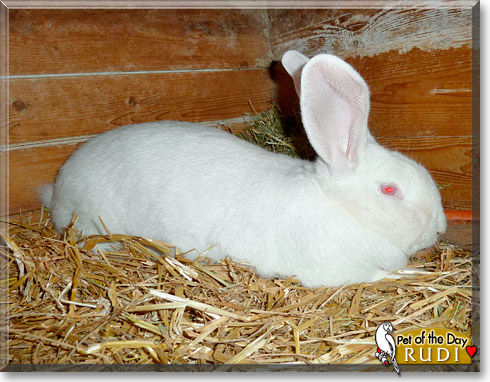
I couldn’t find a groundhog as “Pet Of The Day.” How ’bout a cute little bunny instead?

Rudi, the Pet of the Day
Name: Rudi
Age: Unknown
Gender: Male
Kind: German Giant Rabbit
Home: Benneckenstein, Germany
This is my rabbit Rudi. He has this name because he is so big, like a little dog. He is a “Deutscher Riese” – a German Giant Rabbit.

We got Rudi in 2009. He came to us as a stray. One evening my dad said: “There is something white on the road.” And the next morning, my mum went into our garden and Rudi sat there! We knew that he came from our neighbours, but there he would have been slaughtered. Our neighbour told us: “You can keep him.” And so Rudi was and is still our rabbit.

When it is warm, my sister and I let Rudi out in the garden and play with him. Then Rudi is very happy. He knocks with his feets and jumps into the sky. That is very funny and fun to watch.

Rudi likes to eat very much and sometimes he grunts when we put some new food in his hutch. His favorite food is carrots. Sometimes he is impatient and so he nips but we know he is not bad tempered. I love Rudi very much!!!

Daily Cosmic Calendar for February 2nd

If you are a frequent reader of this calendar, then you know that every so often the cosmos settles down and refrains from blasting earthlings with solar, lunar and planetary discord. Today is one of those one-sided affairs where the potential for good outweighs the potential for its opposite. This is because the only two major celestial alignments are flowing trines of 120-degrees – the first one from the Moon in Gemini to Mercury in Aquarius (6:42AM PST) and the second one happening some 7+ hours later when the Moon forms the same rapport with the Sun in Aquarius (2:02PM PST). Be receptive to visions and insights coming from the great beyond. Think about your higher destiny on Spaceship Earth rather than your personal needs and desires. Literary and educational endeavors as well as cultural and global perspectives win the day over petty peeves and superficial interests. Catch up with email and overseas correspondence. Meanwhile, gear up for a big sea change happening for the planet ruling the oceans as Neptune prepares to enter Pisces for nearly 14 years tomorrow. This orb of dreams, spirituality, religious beliefs and the creative imagination is saying goodbye to Aquarius after a brilliant 14-year run in this third, universal air sign. Now it’s on to the last sign of the zodiac for a trip into unknown waters only Einstein, a double-fish Piscean himself, might perceive with his mystical and kaleidoscopic mind-set.

Calendar of the Moon for Thursday, Feb. 2nd

Calendar of the Moon

Rowan Tree Moon

Color: Orange-red
Element: Fire
Altar: Upon a cloth of orange-red set a row of red candles, Brigid’s cross, and a bell.
Offerings: Votive candles. Quicken a newborn idea into birth.
Daily Meal: Hot drinks with every meal. Keep food warm.

Luis/Gamelion Invocation

Call: Now is the quickening of the year.
Response: Now is the time of the first movement.
Call: Now the child stirs in the womb.
Response: Now the seed stirs in the earth.
Call: Now the plains flood and our fire is threatened.
Response: Now the cold water drowns our spark.
Call: Now is the time of the hard struggle.
Response: Now is the month of desperation.
Call: Now is the time of desperation to live.
Response: Now is the time of desperation to be born.
Call: We turn in our sleep as the earth turns.
Response: We dream with the sleeping earth.
Call: Each of our dreams is a lit candle in the dark.
Response: Each of our dreams is a single point of hope.
Call: They shine faint and alone in the night of struggle.
Response: They are alone as we are alone.
Call: Yet we are not alone in our dreams.
Response: We are not alone!
Call: We will keep our fires burning.
Response: We will burn against the night!
Call: We will warm our dreams with the force of life.
Response: We will not die alone in the cold!
Call: We will ward off all evil.
Response: Only good shall pass our gates.
Call: We will care for each other.
Response: We will never cease to care!
Call: We will survive the winter.
Response: We will survive!
(Repeat last two lines twice more.)

Chant:
Protect the flame that warms your dreams
And dreams shall never die.

Calendar of the Sun for Thursday, Feb. 2nd

Calendar of the Sun
2 Solmonath

Oya’s Day

Colors: Purple, burgundy, dark orange (pottery color), copper
Element: Air
Altar: Lay out the nine sacred items of Oya: the purple cloth, the black flywhisk, the copper crown, the rainstick, the broken pottery rolled up in a woven mat, the earthen pot of candles, the basket of graveyard earth, the buffalo horn, and the glass knife. Burn incense.
Offerings: Plums, eggplants, red wine. The house should be swept thoroughly before the ritual.
Daily Meal: Cooked plums or plum jam. Cooked eggplant. Millet. Red wine. Buffalo meat.

Invocation to Oya

Hail, Lady of the Wind,
Weather goddess most unpredictable,
Whirlwind that sweeps all away
Before its inevitable path!
Hail, Lady of the Rain,
Bringing water to grow
Our crops and slake our thirst!
Hail, Water Buffalo Woman,
Crashing through the underbrush
Unstoppable as fate!
Hail, Carrier of the Container of Fire,
You who can unleash
New beginnings from the ashes!
Hail, Mistress of the Marketplace
Hetaera of the smashed crockery!
Hail, Lady of Death,
Duena de la Cemetaria,
Princess of Graves!
Hail, Keeper of Souls,
Mother of dancing Egungun!
Hail, purifier of the motivations,
In whose mirror we see ourselves,
Who cuts away our illusions!
Hail, Queen of the Air
Whose essence we breathe!

Chant:
O-ya! He-yi! (This should be accompanied by a drum circle, with trance dancing.)

The Wicca Book of Days for February 2nd – Imbolc and Candlemas

Book & Candle Comments 

Imbolc and Candlemas


The festival of Candlemas has ancient roots, for in Pagan Europe, fires were kindled at this time of year to reflect and encourage the growing strength of the sun. Its name is Christian, however, being derived from the tradition of the future year’s supply of candles being blessed before the first mass of February 2, and then being carried around the church in a pious procession. This is also the feast of the purification of the Virgin Mary and the presentation of the infant Jesus in the Temple; the parallel between the Vrgin Mary an the Goddess in her maiden aspect, and Baby Jesus and the Solar Child of Promise, are unmistakable.


 “Candlemas Creativity”

White represents purity, pale green denotes a fresh start and growth and a flame signifies the kindling of creativity. Light candles of these colors to commemorate the concepts symboized by Candlemas. As you gaze at the flaming taper, ask the Goddess for inspiration. 

~Magickal Graphics~