The Wiccan Book of Days for Feb. 1 – Imbolc & Maiden’s Milk

Imbolc/Candlemas Comments
February 1

Imbolc and Maiden’s Milk

Between February 1 and 2, Wiccans celebrate the Sabbat of Imbolc(also known as Oimelc or Candlemas), and the return of the Goddess from the underworld in her maiden or virginal form, as exemplified by the Celtic Goddess Brigit (“High One”), Bride or Brigid the name under which the Christians sanctified her. In Ireland, Brigit was venerated as a protector of livestock, a bestower of fertility upon the natural world, a promoter of healing and a patron of poetry and the blacksmith’s art. Oimelc means “ewe’s milk,” for this was the day on which ewes usually began to lactate, and the Goddess’s association with milk was preserved in the notion of Saint Brigid of Kildare’s cows producing milk thrice daily.

“Flowery Words”

In northern climes, the emergence of early spring flowers is evidence that nature is awakening and that Brigit is among us again, so pick a posy and pour a glass of cow’s milk on the ground as a libation to the Goddess.

Magickal Graphics

Happy & Blessed Imbolc, dear friends!

Imbolc/Candlemas Comments

Imbolc (also Imbolg), or St Brigid’s Day (Scots Gaelic Là Fhèill Brìghde, Irish Lá Fhéile Bríde, the feast day of St. Brigid), is an Irish festival marking the beginning of spring. Most commonly it is celebrated on 1 or 2 February (or 12 February, according to the Old Calendar) in the northern hemisphere and 1 August in the southern hemisphere. These dates fall approximately halfway between the Winter Solstice and the Spring Equinox. 

The festival was observed in Gaelic Ireland during the Middle Ages. Reference to Imbolc is made in Irish mythology, in the Tochmarc Emire of the Ulster Cycle. Imbolc was one of the four cross-quarter days referred to in Irish mythology, the others being Beltane, Lughnasadh and Samhain. It has been suggested that it was originally a pagan festival associated with the goddess Brigid, who should not be confused with St Brigit of Kildare.

In the modern Irish Calendar, Imbolc is variously known as the Feast of Saint Brigid (Secondary Patron of Ireland), Lá Fhéile Bríde, and Lá Feabhra — the first day of Spring. Christians may call the day “Candlemas”. Long celebrated as “the feast of the Purification of the Virgin”.

One folk tradition that continues in both Christian and Pagan homes on St. Brigid’s Day (or Imbolc) is that of the Brigid’s Bed. The girls and young, unmarried, women of the household or village create a corn dolly to represent Brigid, called the Brideog (“little Brigid” or “young Brigid”), adorning it with ribbons and baubles like shells or stones. They make a bed for the Brideog to lie in. On St. Brigid’s Eve (January 31), the girls and young women gather together in one house to stay up all night with the Brideog, and are later visited by all the young men of the community who must ask permission to enter the home, and then treat them and the corn dolly with respect.

Brigid is said to walk the earth on Imbolc eve. Before going to bed, each member of the household may leave a piece of clothing or strip of cloth outside for Brigid to bless. The head of the household will smother (or “smoor”) the fire and rake the ashes smooth. In the morning, they look for some kind of mark on the ashes, a sign that Brigid has passed that way in the night or morning. The clothes or strips of cloth are brought inside, and believed to now have powers of healing and protection.

On the following day, the girls carry the Brideog through the village or neighborhood, from house to house, where this representation of the Saint/Goddess is welcomed with great honor. Adult women — those who are married or who run a household — stay home to welcome the Brigid procession, perhaps with an offering of coins or a snack. Since Brigid represents the light half of the year, and the power that will bring people from the dark season of winter into spring, her presence is very important at this time of year.

Neopagans of diverse traditions observe this holiday in a variety of ways. As forms of Neopaganism can be quite different and have very different origins, these representations can vary considerably despite the shared name. Some celebrate in a manner as close as possible to how the Ancient Celts are believed to have observed the festival, as well as how these customs have been maintained in the living Celtic cultures. Other types of Neopagans observe the holiday with rituals taken from numerous other unrelated sources, Celtic cultures being only one of the sources used.

Imbolc is usually celebrated by modern Pagans on February 1 or 2nd in the northern hemisphere, and August 1 or 2nd in the southern hemisphere. Some Neopagans time this celebration to the solar midpoint between the winter solstice and spring equinox, which now falls later in the first week or two of February. Since the Celtic year was based on both lunar and solar cycles, it is most likely that the holiday would be celebrated on the full moon nearest the midpoint between the winter solstice and vernal equinox, or when the primroses, dandelions, or other spring flowers rise up through the snow, or when the sun aligned with the passage tombs among the pre-Celtic megaliths.

Wikipedia

Magickal Graphics

Crone’s Corner – Imbolc Ideas Having to do with Fire


Crone’s Corner – Imbolc Ideas Having to do with Fire

by Starhawk, Anne Hill, and Diane Baker

Brigit Fire
Whether we circle around a hearth, outdoor bonfire, or kindle a blaze
in a cast-iron cauldron, in the season of Brigit we welcome the
return of light. Here are some suggestions for a safe and cheerful
blaze.

Cauldron Fire
You will need:
a cast-iron pot of any size
a lid that fits snugly, for putting out the fire
bricks, hotplate or other heat-resistant material to set the cauldron
on.
Epsom salts
rubbing alcohol
To keep the blaze going for 45 minutes in a five quart cauldron, you
need 1/2 gallon of Epsom salts and approximately 4 to 6 pints of
rubbing alcohol
Any cast-iron pot can be made into a cauldron with a fire of Epsom
salts and rubbing alcohol. This is a very safe blaze. Once the
cauldron is secured on a heat-proof surface, pour the Epsom salts in
until the bottom is covered, approximately 1 inch deep. Pour rubbing
alcohol over the salts until the alcohol is about an inch higher than
the salts. Hold a lighted match just above the alcohol. The liquid
will light and produce a strong orange flame. The flame burns cool,
unlike a wood fire, and it is difficult to burn things
in. When the flame gets low, cover to snuff out completely. Add more
rubbing alcohol to the cauldron and relight carefully. The warmer the
rubbing alcohol, the more quickly it ignites. This fire recipe leaves
a significant amount of sediment in the bottom of the cauldron. For
this reason, it is best to dedicate a pot strictly for cauldron use.

Kindling a Fire
This holiday is a good time to teach your older children how to set a
fire and kindle a blaze. Most children are eager to help lay a fire,
but may be too scared to light one. Using long matches often eases
their fear, and with supervision they can become quite proficient at
lighting fires. Children are great at gathering wood. A note of
caution about burning found wood, however: Make sure you inspect the
wood. Scrap plywood gives off toxic fumes, as does wood that has been
painted or coated with urethane. Make sure the wood you are burning
has not been coated with creosote. Creosote is a dark, often tarry
preservative and is commonly found on wood washed up on the beach.
Its fumes are toxic, and when burned, the treated wood creates a
smoky, stinky blaze. Creosote is easy to identify by its smell, which
resembles that of turpentine or paint thinner.

Egg Carton Fire Starters
You will need:
paraffin wax or beeswax (old candle stubs work great for this)
the bottom halves of cardboard egg cartons
sawdust, pine needles, scraps of cotton material, dry pinecones, or
shredded paper
scissors
a pot
Reuse all those old candle ends in this practical, convenient fire
project. Stuff each cardboard egg holder with sawdust or other
flammable material. Melt the wax in a pot, over low to medium heat.
When the wax is melted, carefully pour the wax into each depression
in the egg cartons. Make sure the wax does not overflow. Let cool.
After the wax has cooled down, use scissors to cut the fire starters
apart from each other, leaving the hardened wax inside its cardboard
shell. To use, set one or two fire starters in your fireplace,
surround with kindling and larger wood, and light. The fire starters
will keep burning long enough to light even the most stubborn logs.

Fire Safety
Never leave candles lit and a blazing fire unattended. It is a good
idea to have a pail of water or a fire extinguisher close at hand
when having a fire. If you often light fires at your home, try
growing an aloe vera plant, or keep some of the pure gel on hand in
the fridge, to use as first aid for burns. Fires at the beach are
popular in all seasons, and eliminate some of the risks of fires in
the woods or in the meadow. Few people are aware of how to extinguish
a beach fire safely, however. Covering up a beach fire with sand
actually insulates the coals, keeping them burning through the night.
Those hidden coals will still be red-hot in the morning waiting for
an unsuspecting person to step on them. Always douse a beach fire with
water – seawater works as well as fresh water – until there are no
more live coals. Wait for the steam to clear; then using a stick,
turn over all the coals to make sure no smoldering coals remain.

Candle Hat
One holiday tradition in Scandinavian countries is for the girls to
wear garlands in their hair that hold a circle of lit candles and
bless the light’s return. We’ve adapted this candle custom to honor
the returning light for Brigit. These paper hats are a simple and
safe variation. Draw an inner circle on a 9-inch paper plate, about
an inch from the rim. Next draw very light lines dividing the circle
into quarters. Draw four rectangular candle shapes, keeping the
dividing lines as guides for the candles’ centers. The rectangles
will meet in the center of the plate in a small square. Cut out the
candle shapes, preserving their connection to the ring at the rim.
This connection serves as the base of the candle. Bend candles
from their base to stand upright. Decorate candles with markers,
crayons and glitter. use the discarded plate material to cut flame
shapes. Color them bright flame colors, then glue or staple them to
the top of the candles.

Brigit Candles
You will need:
1 recipe salt dough clay
a bowl of water
8 1/2 by 11 inch sheet of paper, one for each candle
wax paper, cut into 8 1/2 by 11 inch sheets, one for each candle tape
1 T vegetable oil
toothpicks
small bowl
candle making supplies
Honor Brigit with new special candles. These candles use molds made
from coiled salt dough ropes so that each completely unique candle
bears the spiral imprint of the coil.

Taper Candles
Make ropes by rolling salt dough clay between your hands. Each rope
should be two or three feet long and 1/4 to 1/2 inch in diameter. If
younger children can’t manage such lengths, have them make smaller
segments that can be joined later with a little pressure and water.
Dip your fingers into the bowl of water occasionally if the dough
tends to crack. Roll the paper into a 1 inch wide cylinder and tape
it shut. Around this cylinder, tape a piece of wax paper. Coat the
wax paper with a thin layer of oil. Lightly moisten a salt dough rope
with water. Lay the paper cylinder on its side at one end of the
rope. Roll it along the dough, wrapping the rope up the cylinder
until it is six inches tall. Be sure the edges of the coiled rope
always touch. To provide extra support, at intervals stick several
toothpicks vertically through the coils. Make a bottom for the mold by
shaping another piece of salt dough into a 3/4 inch thick circle
that’s larger than the coiled tower in diameter. Moisten the bottom’s
surface, then carefully lift the coiled tower onto the bottom piece
and press gently to make a seal. Pull the paper cylinder out. This
slides out easily, leaving the wax paper. Remove it by gently tugging
on the wax paper with one hand while you support the clay coils with
the others. Inspect each part of the mold, looking for tiny cracks
where melted wax could leak. Press these shut. If the coils start to
sag, quickly fashion a paper cylinder around the outside of the coils
and tape it closed. Trim it to the same height as the clay, so it
won’t get in the way when you are pouring wax. Set the mold in
an empty bowl, in case wax leaks through. You are ready to pour.
Pouring the wax is thrilling. Go very slowly up each level to make
sure no wax is leaking through. If a leak appears, carefully pinch it
shut and pour again. Insert the wick. The wax will harden within an
hour, long before the clay dries. To unmold, just unwind the clay. If
some sticks, soak the candle in cool water and then gently rinse off
the clay. The candles have a wonderfully craggy spiral looping from
bottom to top, and burn with a lovely strong flame.

Beehive Candles
You can also make beehive candles with great success by coiling ropes
of salt dough in a small, deep bowl. A rice bowl is the perfect size.
It’s easier to start with making a spiral, about 3 inches across,
outside of the bowl, then transferring this into the bottom of the
bowl. Next coil the rope inside the bowl until you reach the top. The
candle is burned with the dome side up, so the wick has to be
extended through the wax at the bottom of the bowl. When the wax is
firm enough to insert the wick, use a slightly larger straw than
usual, and push it firmly through the candle, into the dough beneath,
straight to the bottom of the bowl. The candle unmolds easily: Lift
candle and mold from the bowl and uncoil the mold.

Brigit Candleholder
To echo the Goddess’s symbol of the serpent, make this candleholder,
which resembles a coiled snake. Follow directions for making a mold
for taper candles, with the following differences:
1. Size your holder by wrapping a paper cylinder around whatever
candle you intend to use. Remove candle before proceeding further.
2. Dough ropes should be about 1/2 inch wide and a foot long. If
candleholder is taller than 4 inches, use toothpicks for extra
support.
3. Make the bottom by coiling a rope into a small circle. 4. After
the paper cylinder has been removed, use your candle to gently test
of the open end of the candleholder is large enough to accommodate
the candle. If it’s too small, delicately press the opening wider. If
it’s too large, fill in with bits of salt dough.
5 Bake the holder as directed. Turn after the first hour to be sure
it does not stick to the pan.
6 Cool completely after baking. Then paint with snaky patterns,
finishing with eyes on the end of the top coil.


(from “Circle Round” By Starhawk, Diane Baker and Anne Hill


Courtesy of Witches Moon


Daily Aromatherapy Tip of the Day for Jan 31


Daily Aromatherapy Tip


One of the best eo’s for extreme anxiety and rapid heart beat is Ylang Ylang. Botanical name Cananga odorata
To achieve these results you’ll need Ylang Ylang Extra or Complete which contain a higher (50%) amount of linalool
not found in poorer grades of Ylang Ylang, (1, 2 0r 3). Enjoy!

Brought to you by AromaThyme.com


Scrying Spell For Love


Scrying Spell For Love

Cast a potent spell to see your true love during the time of the waxing Moon. You will need a scrying mirror for this. Also, you should make a tea using rose hips, dried orange peel, hibiscus, and meadowsweet. Drink the tea, then repeat the names of the herbs until you reach a light state of trance in front of your mirror. Then softly recite this spell:


Through orange peel,
Love I feel,
I wish to know love well.
Rose, powerful flower of love,
Tell me of my true love. Hibiscus flower,
Sight is your power;
share your sight with me.
Meadowsweet,
Your light I see,
Show my true love’s face to me.


Then look into your scrying mirror. You will see the face of your true love.


By: Jenna Tigerhart,


Goddess Of The Day: SARASVATI

Goddess Of The Day: SARASVATI

Festival of Sarasvati (India)

Themes: Learning; Wisdom; Communication
Symbols: White Flowers (especially Lotus); Marigolds; Swans

About Sarasvati:

A Hindu goddess of eloquence and intelligence, Sarasvati extends a refreshing drink from her well of knowledge to complete the month with aptitude. In Hindu tradition, Sarasvati invented all sciences, arts, and writing. In works of art she is depicted as white-skinned and graceful, riding on a swan or sitting on an open lotus blossom.

To Do Today:Today is an excellent time to embark on any course of study or to reinforce your learning in a specific area. In Hindu tradition, Sarasvati’s festival is held on or around this date. During the celebration, students gather in the Katmandu Valley (Nepal) bearing gifts for the goddess, who visits here today. Traditional offerings at the temples include lotus and marigold blossoms and incense, while students bring pens or books to invoke Sarasvati’s aid with their studies. Adapting this a bit, try dabbing your personal tools or educational books with a little lotus oil, and burn any sweet-scented incense to improve your awareness (rosemary is a good choice).

.
To generate Sarasvati’s assistance in matters of communication, find a white flower and remove its petals. Place these in any moving water source, saying:

Sarasvati, let my words bear gentle beauty and truth,
falling gently on other’s ears, even as these petals to the water.

Let the water (which also represents this goddess) carry your wish.

By Patricia Telesco


Celebrations Around The World, Jan. 31st

Feast of Great Typos
Festival of Brigantia begins
Up Helly AA (Viking Festival)
Festival of Imbolc begins
Nauru Independence Day
Festival of Transmission Errors
Child Labor Day
St. John Bosco’s Day (patron of editors, apprentices)
Phlegm-Green, Moldy-Grey, and Gazzard Day (Goblin)
Valkyries’ Day (Norse)
St. Marcella’s Day
Kitchen God Visits Heaven (China)
National Brandy Alexander Day
St. Tryphena’s Day (patron of nursing mothers)

GrannyMoon’s Morning Feast – Source: The Daily Globe, School Of The Seasons and/or The Daily Bleed

Astronomy Picture of the Day

Astronomy Picture of the Day

Discover the cosmos!Each day a different image or photograph of our fascinating universe is featured, along with a brief explanation written by a professional astronomer.

2012 January 31
See Explanation.  Clicking on the picture will download the highest resolution version available.

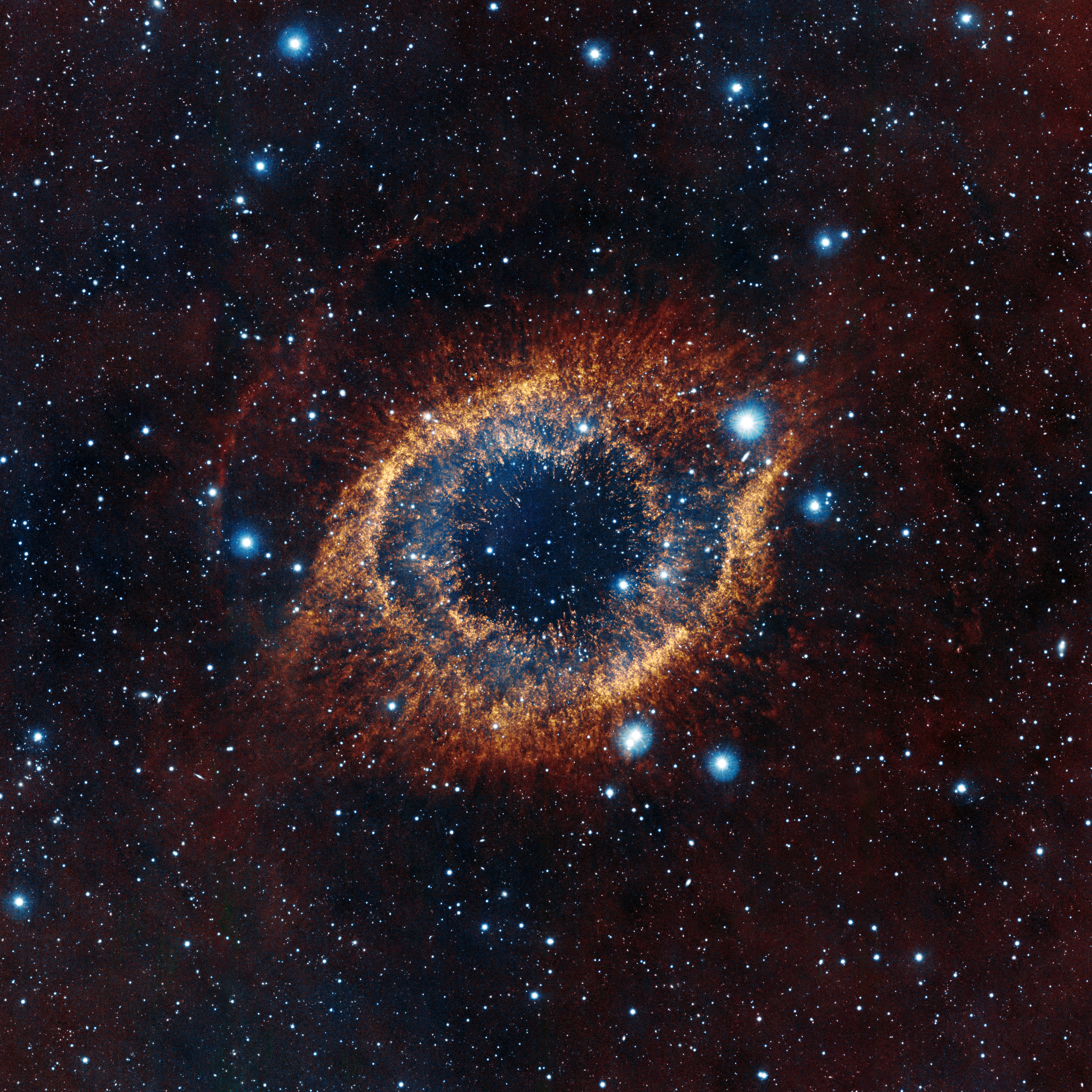
The Helix Nebula from the VISTA Telescope
Credit: ESO/VISTA/J. Emerson; Acknowledgment: Cambridge Astronomical Survey Unit  


Explanation: Will our Sun look like this one day? The Helix Nebula is one of brightest and closest examples of a planetary nebula, a gas cloud created at the end of the life of a Sun-like star. The outer gasses of the star expelled into space appear from our vantage point as if we are looking down a helix. The remnant central stellar core, destined to become a white dwarf star, glows in light so energetic it causes the previously expelled gas to fluoresce. The Helix Nebula, given a technical designation of NGC 7293, lies about 700 light-years away towards the constellation of the Water Bearer (Aquarius) and spans about 2.5 light-years. The above picture was taken three colors on infrared light by the 4.1-meter Visible and Infrared Survey Telescope for Astronomy (VISTA) at the European Southern Observatory’s Paranal Observatory in Chile. A close-up of the inner edge of the Helix Nebula shows complex gas knots of unknown origin.

“Candlemas’ is the Christianized name for the holiday, of course. The older Pagan names were Imbolc and Oimelc. ‘Imbolc’ means, literally, ‘in the belly’ (of the Mother). For in the womb of Mother Earth, hidden from our mundane sight but sensed by a keener vision, there are stirrings. The seed that was planted in her womb at the solstice is quickening and the new year grows. ‘Oimelc’ means ‘milk of ewes’, for it is also lambing season. The holiday is also called ‘Brigit’s Day’, in honor of the great Irish Goddess Brigit. At her shrine, the ancient Irish capitol of Kildare, a group of 19 priestesses (no men allowed) kept a perpetual flame burning in her honor. She was considered a goddess of fire, patroness of smithcraft, poetry and healing (especially the healing touch of
midwifery).”
– Daven’s Journal – Imbolic

Stress Is Not What You Think

Stress Is Not What You Think

  • Ed and Deb Shapiro

Ironically, the holiday season can be the most stressful time of the year. Imagine you are trying to squeeze some toothpaste out of a tube but you have forgotten to take the top off. What happens? Deb actually did this in one of her most unaware moments and the toothpaste soon found another way out through the bottom of the tube and got all over her. It will force a hole in the side or wherever is the weakest point.

Now imagine that the tube of toothpaste is you, under pressure and beginning to experience psychological or emotional stress. But you don’t take your lid off, as it were, by recognizing what is happening and making time to relax or deal with your inner conflicts.

So what happens to the mental or emotional stress building up inside? In her book, Your Body Speaks Your Mind, Deb shows how eventually it has to find a way out and if it can’t come out through the top, as it were, by being expressed and resolved, it will come out somewhere else, whether through your digestion, nerves, immune system, behavior, or sleep patterns. Repressed or ignored stress can manifest as depression, addiction, or anxiety; projected outwards it can become hostility, aggression, prejudice or fear.

We have built into our physiology a fight-or-flight response that enables us to respond to danger if, for instance, we are on the front line of a battle or facing a large bear. The battle may be with your teenage son and bears tend to come in a variety shapes and sizes, such as impatient and angry holiday shoppers. Seemingly unimportant events can even cause a stress reaction, as the brain is unable to tell the difference between real and imagined threats: if you focus on your concern about what might happen it plays as much havoc with your hormones and chemical balance as it does in a real situation.

Recent studies show–as if we didn’t know–that job dissatisfaction, moving house, divorce, and financial difficulties are at the top of the list of known stressors. But we all respond differently to circumstances: a divorce may be a big stressor for one but it may be a welcome relief to another. The difference lies in our response, for although we may have little or no control over the circumstances we are dealing with, we do have control over our reaction to them.

In other words, the cause of stress is not as much the external circumstances, such as having too many demands and not enough time to fill them, as it is our perception of the circumstances as being overwhelming; and our perception of our ability to cope, as when you feel stretched beyond what you perceive yourself to be capable of.

What you believe will color your every thought, word and action. As cell biologist Bruce Lipton says in his book, The Biology of Belief, “Our responses to environmental stimuli are indeed controlled by perceptions, but not all of our learned perceptions are accurate. Not all snakes are dangerous! Yes, perception “controls” biology, but… these perceptions can be true or false. Therefore, we would be more accurate to refer to these controlling perceptions as beliefs. Beliefs control biology!”

In other words, believing that it is your work, family or lifestyle that is causing you stress and that if you could only change these in some way then you would be fine, is seeing the situation from the wrong perspective. It is the belief that it is something out there that is causing the stress. And, although changing the circumstances certainly may help, invariably, no matter what you do, it is a change within your belief system and perception of yourself that will make the biggest difference.

Try It Yourself

If you find yourself feeling stressed, take 10 minutes to breathe more deeply. Most people who are tense breathe short, shallow breaths into the upper part of their chest. If you take slower breaths and deepen your breathing into your belly, the stress will dissolve.

Then find an affirmation that works for you to shift perceptions and belief patterns and to reinforce your strengths, such as: “My mind is at ease and I am capable of doing everything,” or “With every breath I am more relaxed and flowing through my day with ease.”