Top Ten Reasons Why
|
|

Top Ten Reasons Why
|
|
Discover the cosmos! Each day a different image or photograph of our fascinating universe is featured, along with a brief explanation written by a professional astronomer.
2019 June 11
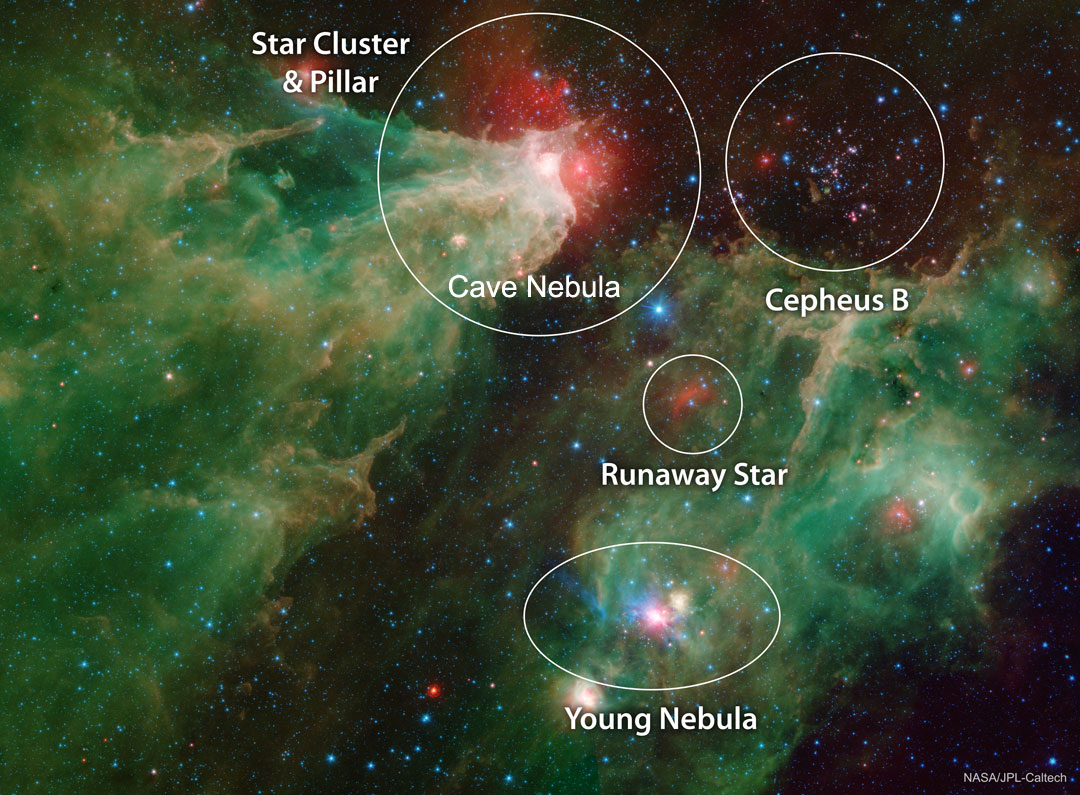
The Cave Nebula in Infrared from Spitzer
Image Credit: NASA, JPL-Caltach, Spitzer Space Telescope
Explanation: What’s happening in and around the Cave Nebula? To help find out, NASA’s orbiting Spitzer Space Telescope looked into this optically-dark star-forming region in four colors of infrared light. The Cave Nebula, cataloged as Sh2-155, is quite bright in infrared, revealing details not only of internal pillars of gas and dust, but of the illuminating star cluster too – all near the top of the image. The red glow around the Cave’s entrance is created by dust heated by bright young stars. To the right is Cepheus B, a star cluster that formed previously from the same cloud of gas and dust. Other interesting stars of Cepheus come to light in infrared as well, including those illuminating an even younger nebula toward the image bottom, and a runaway star pushing a bow shock, tinged in red near the image center. This region spans about 50 light years and lies about 2,500 light years toward the constellation of the King of Aethiopia (Cepheus).
On June 11 and 12, 2019, use the waxing gibbous moon to find Spica, the brightest star in the constellation Virgo the Maiden. In fact, Spica is Virgo’s one and only 1st-magnitude star. Although the bright moon will wipe out a number of fainter stars from the canopy of night tonight, bright Spica should withstand the moonlit glare. If you have trouble seeing Spica, place your finger over the moon and look for a bright star nearby.
We in the Northern Hemisphere associate the star Spica with the spring and summer seasons. That’s because Spica first lights up the early evening sky in late March or early April, and then disappears from the evening sky around the September equinox.
The constellation Virgo stands as a memorial to that old legend of Hades, god of the underworld, who was said to have abducted Persephone, daughter of Demeter, goddess of the harvest. According to the legend, Hades took Persephone to his underground hideaway. Demeter’s grief was so great that she abandoned her role in insuring fruitfulness and fertility. In some parts of the globe, it’s said, winter cold came out of season and turned the once-verdant Earth in to a frigid wasteland. Elsewhere, summer heat was said to scorch the Earth and give rise to pestilence and disease. According to the myth, Earth would not bear fruit again until Demeter was reunited with her daughter.
Zeus, the king of the gods, intervened, insisting that Persephone be returned to her mother. However, Persephone was instructed to abstain from food until the reunion with her mother was a done deal. Alas, Hades purposely gave Persephone a pomegranate to take along, knowing she would eat a few seeds on her way home. Because of Persephone’s slip-up, Persephone has to return to the underworld for a number of months each year. When she does so, Demeter grieves, and winter reigns.
The constellation Virgo is linked to Demeter (and also Ishtar of Babylonian mythology, Isis of Egyptian mythology and Ceres of Roman mythology). Virgo is seen as a Maiden, associated with the harvest and fertility. The Latin word spicumrefers to the ear of wheat Virgo holds in her left hand. The star Spica takes its name from this ear of wheat. Each evening, if you watch at the same time, you’ll see Spica slowly shift westward, toward the sunset direction. Eventually, Spica will get so close to the sunset that’ll fade in the glare of evening twilight. Once Spica disappears from the evening sky, we at northerly latitudes must harvest our crops and put away firewood, because the cold winter season is on its way.
The constellations of the zodiac – like Virgo – define the sun’s path across our sky. Putting it another way, each year, the sun passes in front of all the constellations of the zodiac. This year, 2019, the sun leaves the constellation Leo to enter the constellation Virgo on September 17, 2019. Then the sun leaves the constellation Virgo to enter the constellation Libra on October 31, 2019 (Halloween).
Three other 1st-magnitude zodiacal stars join up with Spica to help sky gazers to envision the ecliptic – the sun’s annual path in front of the backdrop stars: Aldebaran, Regulus, Spica, Antares and Aldebaran. Every year, the sun has its annual conjunction with Aldebaran on or near June 1, Regulus on or near August 23, Spica around mid-October, and Antares on or near December 1.
Of course, all these stars are invisible on their conjunction dates with the sun because they are totally lost in the sun’s glare at that time. However, six months before or after these stars’ conjunction dates, these stars are out all night long. Six months one way or the other of their conjunction, these stars reside opposite the sun in the sky and therefore stay out all night (Regulus around February 23, Spica around mid-April, Antares around June 1 and Aldebaran around December 1).
Bottom line: Use the moon to see the star Spica at nightfall on June 11 and 12, 2019, and celebrate this star’s presence in the evening sky.
Published on EarthSky.org


This 9 indicates that you are being called to teach but you have a disdain for the classroom. There are other ways of teaching that do not include standing before others who are judging you or expressing boredom. Start with what you love to do and work through ways of using your interests as tools to educate. Your enthusiasm is what will make teaching seem less like a chore. People are attracted to those who are enjoying their lives; it will be the very thing that helps them decide to engage in what you have to say. No one will ever realize that what you share is a teaching moment.

The willow tree is often found growing along rivers and in areas of high water concentration. In nature it can protect riverbanks, but in human populated areas it can be a destructive force to drainage systems and walkways. This is why the letter Saille, the willow, is often associated with emotions, dreams, and the subconscious. It is a tree that longs to break up our outer protective world to get into the deep recesses to find more water and nourishment. Drawing this letter is a cause for serious soul searching.
Fortune – When you see this Ogham it is time to take a long look into your subconscious and innermost thoughts! Your soul knows the answer you seek!
 The Witchcraft Chronicles
You must be logged in to post a comment.